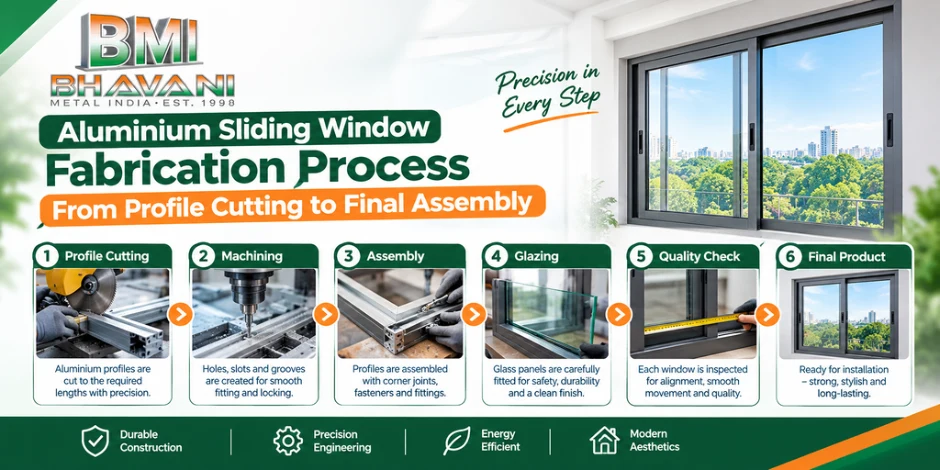
Aluminium Sliding Window Fabrication Process: From Profile Cutting to Final Assembly
Two windows can look identical on the day of handover and perform very differently after three monsoons. The difference is usually decided in the workshop, not on site: how accurately profiles are cut, how drainage slots are machined, and how carefully each frame is assembled and checked.
This article walks through how Bhavani Metal fabricates an aluminum sliding window in India , from profile cutting to final assembly. It also lists the checks B2B buyers can ask any manufacturer to demonstrate, whether the project is an aluminium sliding window in Mumbai or elsewhere.
What Is Aluminium Sliding Window Fabrication?
Aluminium sliding window fabrication is the workshop process that turns finished aluminium profiles, glass, hardware and seals into made-to-measure window units. It covers cutting, machining, assembly, glazing, inspection and packing, and it sets the window's dimensional accuracy, operation and weather performance.
Profiles arrive as extruded lengths, typically 6063 alloy, already finished by powder coating or anodising. The fabricator does not make the extrusion; it converts standard lengths into frames and sashes that match each opening on the approved shop drawing.
- Starting material: Extruded 6063-T5 profiles, finished before or after fabrication depending on the process [confirm Bhavani Metal's sequence and profile source]
- Main stages: Order check, cutting, machining, assembly, glazing, inspection, packing
- Output: Made-to-measure frames and sashes labelled by floor and unit
- Key controls: Cut length, squareness, drainage slots, roller alignment, seal fit
- Relevant standards: IS 1948 (aluminium windows), IS 1868 (anodic coatings), IS 2553 (safety glass)
The Fabrication Process, Step by Step
The process runs in eight stages: drawing and material check, profile cutting, machining, surface protection, frame assembly, glazing and hardware fitting, quality inspection, and labelled packing. Each stage has a check that prevents defects from reaching the site.
1. Drawing release and material check
Fabrication starts from the approved shop drawing and window schedule, not from site guesses. Profiles are checked against the order for series, colour, finish and length, and for visible damage such as scratches or dents.
2. Profile cutting
Profiles are cut to the sizes on the cutting list using a mitre or double-head saw, depending on the joint design. Accurate cut length matters because small errors compound at the corners and show up later as uneven gaps or stiff sashes.
Bhavani Metal to add: cutting equipment, tolerance standard and how the first cut of each batch is verified.
3. Machining
Cut profiles are machined for the features that make a sliding window work:
- Drainage slots and weep holes at the sill
- Lock and latch cut-outs on the sash stile
- Roller and screw positions
- Notches for interlocks and end caps
This stage determines whether rainwater drains out or into the room. Slot position and size should match the system manufacturer's detail.
4. Surface protection and handling
If profiles are already coated, the focus is protecting the finish: protective film stays on, cut ends are kept clean, and profiles are stored on padded racks. Scratches that expose bare aluminium should be touched up with a compatible product.
5. Frame and sash assembly
Frames and sashes are joined with corner cleats and screws, with sealant applied where the joint design requires it. The assembler checks the diagonals, because equal diagonals confirm the frame is square. A frame that is out of square will bind the sash no matter how good the rollers are.
6. Glazing and hardware fitting
Glass is set into sashes with gaskets or glazing tape and beads. Then rollers, locks, anti-lift blocks, stoppers and pile seals are fitted. Glass thickness and type must match the order: toughened glass is common, and double-glazed or laminated units need heavier-duty rollers
7. Quality inspection
Each unit is checked before it leaves the workshop (see the table below).
8. Labelling and packing
Units are labelled by project, tower, floor and unit number, then packed with edge protection to match the installation sequence. Good labelling saves hours on site and prevents wrong-size installation.
Key Quality Checks Before Dispatch
Before dispatch, check overall dimensions, diagonal equality, drainage slot clearance, smooth sash travel, lock alignment, gasket and pile seal fit, glass condition and finish damage. Record results per unit so any defect can be traced to a batch or operator.
| Check | What to verify | Why it matters |
|---|---|---|
| Overall size | Width and height against the schedule | Prevents installation gaps and rework |
| Diagonals | Both diagonals equal within the tolerance on the drawing | Confirms the frame is square and the sash will not bind |
| Drainage slots | Open, correctly positioned, free of burrs | Prevents water ingress at the sill |
| Sash operation | Smooth glide through the full travel, no rubbing | Detects roller misalignment early |
| Locking | Lock engages without force; strike aligned | Avoids security and sealing issues |
| Seals | Pile and gaskets continuous and seated | Reduces air, dust and noise leakage |
| Glass | Correct type and thickness, no chips or scratches | Avoids breakage and rejection |
| Finish | No damaged edges or exposed metal | Protects long-term appearance |
Ask your supplier to show the inspection record for a recent batch. A document with unit numbers and readings is stronger evidence than any verbal assurance.
Benefits for Developers and Contractors
Workshop fabrication gives B2B buyers consistent quality across hundreds of units, faster installation, less on-site rework and traceable records. Controlled conditions also allow better cutting accuracy, cleaner glazing and easier inspection than site-built windows.
| Fabrication Practice | Business Outcome |
|---|---|
| Made-to-measure cutting from approved drawings | Fewer fitment problems and rework costs |
| Machined drainage slots to system detail | Lower risk of leakage claims after handover |
| Unit-wise inspection records | Traceability if a defect appears later |
| Floor-wise labelling and packing | Faster, cleaner installation sequence |
| Standardised sizes and batches | Predictable delivery and lower per-unit cost |
Workshop Fabrication vs Alternatives
Factory-fabricated aluminium windows give tighter tolerances and traceable quality compared with site-built units. Ready-made stock windows are cheaper but limited in size, while imported systems may offer premium hardware at higher cost and longer lead times.
| Approach | Accuracy | Customisation | Quality Traceability | Typical Suitability |
|---|---|---|---|---|
| Workshop-fabricated (made to measure) | High | High | Strong with inspection records | Residential and commercial projects |
| Site-built by local contractors | Variable | Medium | Weak | Small repair or minor works |
| Standard stock sizes | Medium | Low | Medium | Budget projects with standard openings |
| Imported complete systems | High | Medium | Strong | Premium projects with long lead time |
Pricing Factors
Fabrication cost depends on profile series and weight, finish, glass specification, hardware quality, window size and complexity, order volume, delivery logistics and installation scope. Aluminium metal rates also move quotations, so compare itemised bids on the same specification.
- Profile series and section weight: heavier sections cost more and carry larger glass.
- Aluminium market rate: affects raw material cost; check the quotation's validity period.
- Finish: anodising or premium powder coats cost more than a standard coat.
- Glass: double-glazed, laminated or Low-E units add significantly.
- Hardware: sealed-bearing rollers and better locks raise cost and extend life.
- Size and customisation: large or irregular openings need extra machining and heavier hardware.
- Quantity: repeat sizes reduce setup time per unit.
- Logistics and height: delivery in dense cities like Mumbai and high-rise installation add cost.
- Scope: supply only versus providing and fixing, including sealants and mesh shutters.
Share your drawings with Bhavani Metal for an itemised quotation instead of relying on one rate per square foot.
Frequently Asked Questions
How is an aluminium sliding window fabricated?
Fabrication converts extruded aluminium profiles into made-to-measure windows through cutting, machining, frame and sash assembly, glazing, hardware fitting, inspection and packing. Each stage follows the approved shop drawing so units fit the openings without rework.
Which alloy is used for an aluminum sliding window in India?
Most window profiles use 6063 alloy, commonly in T5 temper, for good extrudability, surface finish and adequate strength. Confirm alloy, wall thickness and finish with the supplier's datasheet and ask for test or mill certificates where available.
Why are drainage slots important in a sliding window?
Drainage slots let rainwater collected in the sill track flow outside. If slots are missing, blocked or badly placed, water backs up and enters the room. They are machined during fabrication and should match the system's detail drawing.
What quality checks should be done before dispatch?
Check dimensions, equal diagonals, drainage slot clearance, sash travel, lock alignment, seal fit, glass condition and finish. Keep unit-wise records so defects can be traced. Ask your supplier to show recent inspection sheets.
How long does fabrication take for a project order?
Lead time depends on order size, finish, glass availability and approvals. Shop drawing approval and a mock-up usually come before bulk production. Ask Bhavani Metal for a schedule tied to your floor-wise readiness. [Insert typical lead time if verified.]
Does Bhavani Metal provide aluminium sliding window providing and fixing in India?
Bhavani Metal supplies aluminium sliding windows for B2B projects and can quote supply with installation. Share your window schedule and drawings to confirm scope, locations served including Mumbai, and timelines.
A dependable aluminum sliding window in India is built through controlled steps: accurate cutting, correct machining, square assembly, careful glazing and recorded inspection. Buyers who ask to see these steps, and the records behind them, reduce the risk of defects long before installation begins.
For projects needing an aluminium sliding window in Mumbai or across India, Bhavani Metal can fabricate to your approved drawings and quote aluminium sliding window providing and fixing in India under one scope.