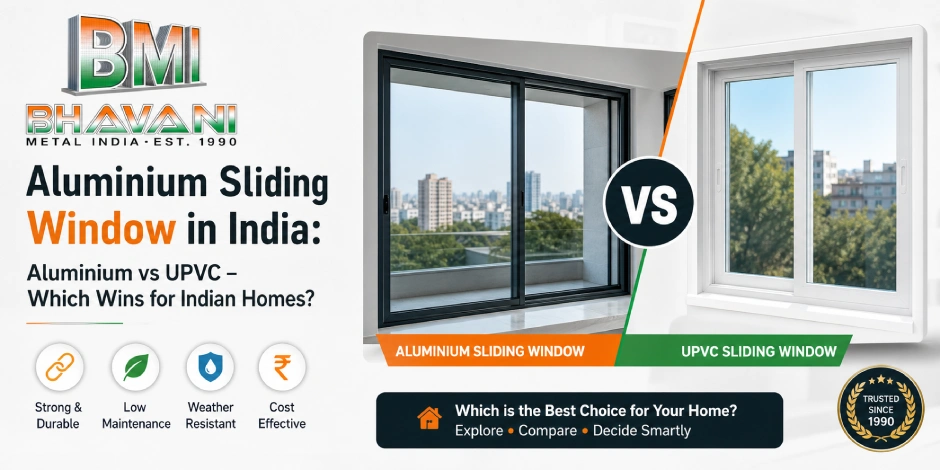
Aluminium Sliding Window in India: Aluminium vs UPVC - Which Wins for Indian Homes?
If you've stood on a construction site in Mumbai during July, you already know why window material choice isn't cosmetic - it's structural. Rain lashes sideways, salt air eats through cheap hardware in under two years, and a window that seals badly in monsoon means damp patches on your wall by September. We've fabricated aluminium, steel, and glass systems for 30+ years out of our Mumbai facility, and the aluminium-vs-UPVC question comes up on nearly every residential site visit we do.
For most Indian homes, an Aluminium Sliding Window outperforms UPVC on heat tolerance, structural strength for larger openings, and long-term maintenance in coastal or high-UV zones. UPVC edges ahead only in raw thermal insulation for extreme cold climates - which barely apply across most of India.
Why This Comparison Matters More in India Than Elsewhere
Window guides written for European or North American markets assume snow, sub-zero winters, and mild summers. That's not our climate. Most of India deals with intense UV exposure, high humidity, dust, and in coastal cities, salt-laden air that corrodes cheap fittings fast.
An Aluminium Sliding Window in India has to survive 40°C+ summers without warping, monsoon humidity without swelling, and - in cities like ours - salt spray without pitting. Material choice here isn't about matching a European spec sheet. It's about what actually holds up on a Mumbai balcony facing the sea.
Aluminium Sliding Windows: What We See on Real Projects
We've installed aluminium sliding systems on everything from 1BHK renovations in Thane to full facade glazing on commercial towers. A few things stand out after three decades of doing this.
- Strength-to-weight ratio: Aluminium frames handle larger glass panels without sagging. On a typical 5x4 ft sliding window, we can run a slimmer frame profile than UPVC would allow for the same span, because aluminium doesn't need the bulk to stay rigid.
- Heat and sun exposure: Powder-coated aluminium doesn't yellow or go brittle under years of direct sun the way some UPVC profiles do, especially the lower-grade imported stock that flooded the market around 2015-2018. We've replaced UPVC frames that turned chalky and cracked at the corners within 5-6 years of west-facing sun exposure.
- Corrosion resistance with proper coating: This is where fabrication quality matters more than material theory. A poorly anodized aluminium frame near the coast will pit within 3 years. A properly anodized or powder-coated frame, done to the right micron thickness, easily runs 15-20 years without visible corrosion - we still service window installations from the early 2000s that are structurally sound.
- Fire behavior: Aluminium doesn't burn or release toxic fumes the way PVC-based materials can under sustained heat. For ground-floor commercial units near kitchens or electrical panels, this isn't a minor point - it's a compliance question in several municipal codes.
Where Aluminium Sliding Windows Fall Short
They're not silent - thermal breaks help but a basic aluminium frame conducts more heat and cold than UPVC. In a non-AC bedroom in Nagpur summers, that matters slightly. And without a thermal break profile, condensation can form on the frame interior during Mumbai's humid months. We recommend thermal-break aluminium for any client doing full-home AC integration.
UPVC Windows: The Honest Picture
UPVC has real advantages, and we install it too when it's the right fit - mostly in high-rise apartments with heavy AC dependence, or northern India projects where winter insulation actually matters.
UPVC frames insulate better against heat transfer by default, since the material itself conducts less than uncoated aluminium. They're also naturally resistant to rust, since there's no metal to corrode.
But UPVC has its own failure points we've seen repeatedly: the frames expand and contract more with temperature swings, which over 8-10 years can loosen hardware and cause hinge sag. Dark-colored UPVC (increasingly popular for modern facades) absorbs more heat and can warp faster than white or grey. And UPVC frames generally can't span as wide an opening as aluminium without internal steel reinforcement, which adds cost and defeats some of the "lightweight" advantage.
Aluminium vs UPVC: Decision Framework
| Factor | Aluminium Sliding Window | UPVC Window |
|---|---|---|
| Coastal/salt air durability | Excellent (with proper anodizing/PC coating) | Good, but hardware can corrode |
| Large window spans (5ft+) | Handles well, slim frames | Needs steel reinforcement |
| Thermal insulation | Moderate (better with thermal break) | Higher by default |
| Sun/UV exposure over 10+ years | Holds color, doesn't warp | Can yellow, warp in dark shades |
| Fire safety | Non-combustible | Combustible under sustained heat |
| Cost (mid-range) | Slightly lower for large openings | Slightly higher due to reinforcement needs |
| Maintenance | Wipe-clean, occasional lubrication | Wipe-clean, hardware checks needed |
If your home faces heavy coastal exposure, direct west/south sun, or needs large glass spans for a modern open layout - then an Aluminium Sliding Window is the more durable long-term choice.
If you're in a colder northern climate with heavy winter heating needs and smaller window openings - then UPVC's insulation edge may justify the trade-off.
What Actually Determines Window Lifespan (It's Not Just Material)
Here's something most comparison articles skip: fabrication quality matters more than the material debate. We've seen premium aluminium fail early because of poor gasket sealing, and budget UPVC last a decade because installation was done right - square frames, correct drainage slots, quality hardware.
For any Aluminium Sliding Window Mumbai homeowners are considering, ask the fabricator three things: the anodizing/coating micron thickness, the hardware brand (roller quality determines how smooth the slide stays after year 3), and whether weep holes are cut correctly for monsoon drainage. Skip any of these and even the best aluminium alloy will underperform.
Cost Reality for Indian Homeowners
Rough per-square-foot pricing (fabrication + installation, mid-range hardware) tends to run close between the two for standard sizes, with UPVC sometimes costing more once you factor in reinforcement for larger openings. [NEEDS CLIENT INPUT - insert current per-sq-ft pricing range for accurate figures]. The bigger cost driver isn't material - it's glass thickness, hardware grade, and whether you're doing single or double glazing.
Our Take After 30+ Years of Fabrication Work
For Mumbai, coastal Gujarat, Chennai, and most of peninsular India, we recommend aluminium sliding systems on the majority of residential and commercial projects we quote. The climate math favors it - heat tolerance, UV stability, and corrosion resistance when properly coated outweigh UPVC's modest insulation edge in a climate that rarely sees genuine cold.
That's not a blanket rule though. A north-facing apartment in Shimla with heavy winter heating needs is a different conversation than a sea-facing flat in Bandra. The right call depends on orientation, climate zone, opening size, and budget - which is exactly the kind of site-specific assessment a fabricator should walk you through before you commit to either material.
If you're planning a renovation or new build and want an honest read on which system fits your specific site conditions, that's a conversation worth having before the order gets placed, not after the frames arrive.
Frequently Asked Questions
Is aluminium or UPVC better for coastal homes in India?
Aluminium, when properly anodized or powder-coated, handles salt air and humidity better over the long term. UPVC hardware components can corrode faster in coastal conditions despite the frame itself resisting rust.
How long does an Aluminium Sliding Window last in Mumbai's climate?
With correct coating and installation, aluminium sliding windows commonly last 15-20 years in Mumbai's humid, coastal conditions, provided drainage weep holes and gaskets are maintained.
Are UPVC windows more soundproof than aluminium?
UPVC has a slight edge in sound and thermal insulation due to the material's lower conductivity, but the difference is often smaller in practice than double glazing or gasket quality contributes.
Which is cheaper - aluminium or UPVC windows in India?
Pricing is close for standard sizes, but aluminium often works out more cost-effective for larger openings since it doesn't need the steel reinforcement UPVC requires at wider spans.
Can Aluminium Sliding Windows handle large glass panels without sagging?
Yes - aluminium's strength-to-weight ratio allows slimmer frames to support larger glass panels than UPVC can manage without added reinforcement, making it common in modern open-layout homes.
Do aluminium windows rust in humid or coastal areas?
Aluminium itself doesn't rust, but poor-quality or thin anodizing can lead to pitting and corrosion near the coast within a few years. Proper coating thickness is the deciding factor, not the metal itself.