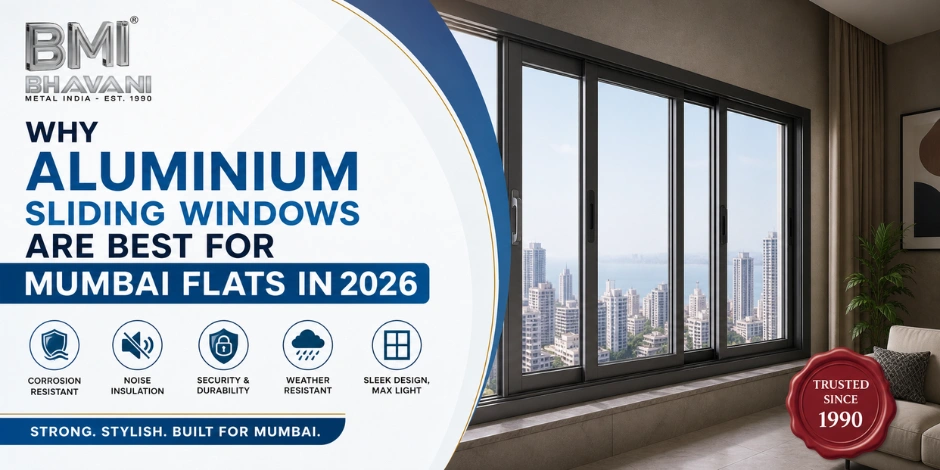
Why Aluminium Sliding Windows Are Best for Mumbai Flats in 2026
Mumbai's housing stock is unlike anywhere else in the country. You have 650-square-foot flats in Andheri sitting next to new-build towers in Thane, coastal bungalows in Bandra sharing the skyline with glass-clad offices in BKC. What ties all of these together is one surprisingly overlooked decision - the window.
Aluminium sliding windows have quietly become the go-to choose for builders, architects, and flat owners across the city. Not because of marketing, but because the material genuinely suits the way Mumbai is built, the way its weather behaves, and the way its residents actually live.
This post breaks down exactly why that is - the practical reasons, the design reasons, and a few things most window guides won't bother telling you.
Mumbai's Climate Makes Most Window Materials Struggle
The city sits on the coast, which means high humidity for most of the year and a monsoon that doesn't ease up gently - it arrives with 200mm of rain in a single day during peak season. Wood warps. Steel corrodes faster than manufacturers like to admit. uPVC can hold its shape but fades badly under sustained UV exposure.
Aluminium handles all of this without protest. It doesn't absorb moisture, it doesn't expand significantly when temperatures swing, and a good powder-coated or anodised finish keeps the surface looking sharp even after several monsoon cycles.
For buildings closer to the sea - Worli, Cuffe Parade, Versova - salt air is an additional challenge. Marine-grade aluminium alloys are specifically processed to handle saline environments, which is why you'll see them specified on high-end coastal projects across South Mumbai.
Space Is the Real Constraint - And Sliding Windows Respect That
Ask any Mumbai resident what they'd change about their flat and 'more space' comes up before anything else. A casement or top-hung window swings outward, which means you can't place a sofa, a desk, or a plant directly in front of it without interfering with the operation.
Sliding windows move laterally within the same wall plane. Nothing protrudes, nothing swings, and the entire usable floor area stays intact. In a 2BHK where every centimetre matter, that's not a small advantage - it's a meaningful one.
The Track System Matters More Than Most People Realise
Not all sliding windows are made the same. A 2-track system allows two panels to slide past each other, giving you up to 50% ventilation opening. A 3-track system with three panels can open much wider - often the better choice for living rooms facing a garden or balcony.
The quality of the rollers, the depth of the track, and the weather-stripping at the sill all determine whether the window stays smooth to operate after five years or becomes a daily frustration. These details are worth asking about before placing any order.
What Changes When You Work with a Dedicated Aluminium Sliding Window Manufacturer in Mumbai
Buying off-catalogue and buying from a manufacturer who actually fabricates the profiles are two very different experiences. When you source from a local aluminium sliding window manufacturer in Mumbai, the specifications can be matched exactly to your site - the frame depth, the glass type, the handle position, the colour finish, and even the locking mechanism.
For residential projects, that typically means getting the window size fitted to the exact opening rather than adjusting the opening to a standard product. For commercial projects, it means the entire facade can follow a consistent design language without compromise.
There's also the question of after-sales support. A manufacturer with a local presence can address a faulty track or a weather-strip that needs replacing without the delays that come with sourcing replacements from out of state. That ongoing relationship is something catalogue buyers often discover they need only after a problem surface.
Glass Options Change What the Window Actually Does for You
The aluminium frame gets most of the attention, but it's the glass that determines how your flat actually feels. Clear float glass is the standard option and works well for most internal rooms. But for a west-facing bedroom in Malad or a living room above a busy road in Dadar, there are better choices.
Heat-reflective glass significantly reduces solar heat gain, which matters when afternoon sun hits a window directly and pushes the room temperature up by several degrees. Acoustic laminated glass - two panes bonded with a polymer interlayer - reduces traffic and construction noise considerably, which anyone living near a Western Railway station can appreciate.
Double glazing, once considered uncommon in Indian residential construction, is being increasingly specified in premium projects because of the energy savings it delivers in air-conditioned spaces. A good aluminium sliding window today is really a system - frame, glass, gaskets, and hardware working together.
Longevity and Long-Term Value - The Numbers That Actually Matter
A well-fabricated aluminium window doesn't need repainting. It doesn't need annual sealing. The maintenance work is minimal - cleaning the track, wiping the frame, occasionally lubricating the rollers. That's it.
Compared to wooden windows, which require refinishing every few years and are particularly susceptible to Mumbai's wet season, or to steel frames that need rust prevention treatment, the total cost of ownership over a ten-to-fifteen-year period shifts noticeably in aluminium's favour.
For flat owners who are renovating before selling, buyers in Mumbai's current market respond well to updated aluminium sliding windows with tinted or tempered glass - it reads as a quality upgrade without requiring major structural changes.
Builders working on mid-range and premium residential projects increasingly factor window quality into their spec because buyers are more informed now than they were even three years ago. Asking about the frame material, the glass specification, and the track quality is becoming a normal part of flat visits - not the exception.
Design Flexibility That Fits Mumbai's Range of Architecture
One of the quieter strengths of aluminium as a material is how well it takes colour. Powder coating can produce anything from matte black to warm champagne to a deep charcoal grey - which means the window frames can work with traditional building exteriors as naturally as they do with modern minimalist facades.
Slim-frame profiles, which have become popular in premium residential developments, are only possible in aluminium because the material has the structural strength to support large glass panels with narrow frames. uPVC needs wider profiles for the same span, which changes the visual proportion of the window considerably.
For older buildings undergoing renovation - the kind you find in Chembur, Matunga, or Mulund - replacing existing steel or wooden frames with custom aluminium sliding windows can visually update the entire facade without touching the original structure.
The Right Window Is a Decision Worth Getting Right Once
Windows are not a category where going with the cheapest available option pays off. The opening is fixed once the building is done - and whatever goes into it will be there through monsoons, heat waves, and years of daily use.
An aluminium sliding window, specified correctly for the building type and location, is an investment that genuinely holds its value. Whether you're fitting out a new flat, renovating an older one, or managing a commercial project across multiple floors, getting the specification right at the start saves a significant amount of correction later.
Bhavani Metal has been fabricating aluminium systems for residential and commercial projects in Mumbai since 1990. If you're working on a project and want to understand what's actually possible with the right materials and the right approach, talking to the team directly is the best place to start.