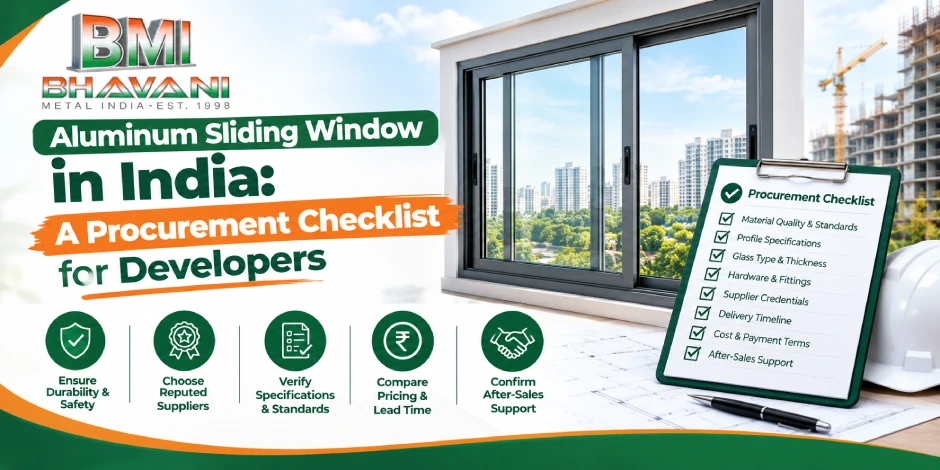
Aluminum Sliding Window in India: A Procurement Checklist for Developers
A window that leaks in the first monsoon becomes a snag list, a warranty claims and a reputation problem. For developers, the aluminum sliding window in India is one of the most repeated components in a project, so one weak specification multiplies across every flat.
Bhavani Metal manufactures and supplies the aluminium sliding window for residential, commercial and institutional projects. This checklist shows what to specify, verify and negotiate, whether your site is in Mumbai or elsewhere, so the window you approve at mock-up is the window installed on the last floor.
What Is an Aluminium Sliding Window?
An aluminium sliding window has glazed panels that glide horizontally on tracks inside an extruded aluminium frame. It needs no swing clearance, resists corrosion, and handles wide openings, which is why developers use it for balconies, bedrooms and office façades.
The system has a perimeter frame, one or more sashes, rollers, interlocking stiles with pile seals, drainage slots, locks and glazing. Most Indian window work uses 6063 alloy sections, finished by powder coating or anodising.
- Product:Aluminium sliding window, 2-track and 3-track configurations [confirm series offered by Bhavani Metal]
- Alloy: 6063-T5 extrusions
- Finish: Powder coat (generally 60 to 80 microns) or anodising
- Glass: 5–6 mm toughened, or double-glazed units where specified
- Reference standards: IS 1948 (aluminium windows), IS 1868 (anodic coatings), IS 2553 (safety glass), IS 875 Part 3 (wind loads)
- Typical scope: Providing and fixing, against approved shop drawings
Key Features to Specify
The features that matter in procurement are alloy and temper, minimum wall thickness, finish thickness, roller quality, drainage design, glazing and seals. These can be verified on paper and on site, unlike adjectives such as "premium" or "durable."
- Extruded 6063-T5 profiles:ask for section weight in kg per metre for every profile in the quotation.
- Stated wall thickness:window series commonly fall between about 1.2 mm and 2.0 mm; heavier series suit larger sashes.
- Powder coat or anodised finish: request coating thickness and the applicator's warranty in writing.
- Sealed-bearing rollers:rated for the actual sash weight, with anti-lift blocks fitted.
- Concealed drainage: weep holes with baffles or covers so wind-driven rain does not enter.
- EPDM gaskets and mohair pile: UV-stable seals at the interlock and glazing.
- Stainless-steel fasteners: avoids galvanic staining, important in coastal conditions.
- Optional mesh track: a third track for an insect-screen shutter on 3-track units.
Bhavani Metal to add: its own series names, profile depths, maximum sash weight and hardware brands from the product datasheet.
Benefits for Developers and Contractors
For B2B buyers, aluminium sliding windows reduce post-handover maintenance, speed up installation through factory fabrication, and keep unit quality consistent across floors. Each benefit below links to a measurable outcome in cost, schedule or customer satisfaction.
| Benefit | Business outcome |
|---|---|
| Corrosion-resistant frames | Fewer finish and rust complaints after handover |
| Factory-made, made-to-measure units | Faster installation and less on-site rework |
| No swing space needed | More usable floor area in compact bedrooms and balconies |
| Standardised sizes across towers | Lower per-unit cost and simpler spare-parts stocking |
| Replaceable rollers, seals and locks | Lower lifecycle cost; the frame outlasts wear parts |
| Recyclable material | Supports green-building documentation (IGBC, GRIHA) |
Pros and cons at a glance
| Pros | Cons |
|---|---|
| Slim frames, more glass and daylight | Only part of the opening ventilates at one time |
| Long service life with low upkeep | Tracks need periodic cleaning |
| Suits wide openings and high-rise loads | Standard profiles conduct heat without a thermal break |
How the Procurement Process Works
A sound procurement sequence is: define performance needs, issue a written specification, compare itemised bids, approve shop drawings, test a mock-up, then release bulk production and installation. Skipping the mock-up is the most common cause of avoidable defects.
- Define requirements: wind load (from IS 875 Part 3 and your structural consultant), water tightness, acoustic and thermal targets.
- Issue a specification: alloy, wall thickness, finish, glass, hardware, sealants, warranty.
- Share the window schedule: sizes, quantities, floors and orientations.
- Compare bids line by line:section weights, hardware brands and glass specification, not just the rate per sq ft.
- Approve shop drawings: check head, sill and jamb details and anchor spacing.
- Build and test a mock-up: check operation, finish and run a water-spray test.
- Phase production and delivery to match floor readiness.
- Install, inspect and hand over with a snag list, warranty and maintenance notes.
For aluminium sliding window providing and fixing in India, ask who performs installation. In-house crews are easier to hold accountable than multiple sub-contractors.
For an aluminium sliding window in Mumbai , schedule sealant work outside peak monsoon where possible. Sealants bond poorly to damp surfaces, and perimeter joints are where most leaks start.
Aluminium Sliding Windows vs Alternatives
Aluminium suits large openings, high-rise loads and slim sightlines. UPVC offers better insulation at smaller sizes, timber suits heritage styling but needs upkeep, and mild steel is strong but requires protective coating. Choose by span, climate exposure and lifecycle budget.
| Criteria | Aluminium | UPVC | Timber | Mild steel |
|---|---|---|---|---|
| Large spans | Excellent | Limited | Limited | Good |
| Monsoon and humidity | Excellent with coating | Excellent | Poor without upkeep | Poor without protection |
| Thermal insulation | Low (high with thermal break) | Good | Good | Low |
| Maintenance | Low | Low | High | High |
| Sightlines | Slim | Bulkier | Bulky | Slim to moderate |
Why Choose Bhavani Metal
Choose a window supplier on verifiable evidence: manufacturing capability, tested systems, installation capacity, references and written warranties. Bhavani Metal's credentials below should be backed by documents you can request during vendor evaluation.
The details below are placeholders. Replace each with verified information and supporting documents.
- Experience: [X] years in aluminium window manufacture; [number] projects delivered; [city and state coverage].
- Specialisation: Aluminium sliding windows for developers, with fabrication to approved shop drawings.
- Manufacturing: [Workshop location, area, machinery such as cutting and machining lines, monthly capacity].
- Quality systems: [ISO 9001 or other certification, if held]; section weights stated per profile.
- Testing: [Third-party or in-house test reports for water tightness, air infiltration and structural performance, if available].
- Installation: [In-house crews and safety practices for high-rise work].
- References: [Named projects, with client permission, plus site visit availability].
- Warranty: [Finish, hardware and workmanship terms, in writing].
What we recommend you verify: visit the workshop, see a completed site, ask for the mock-up process, and compare the quotation against your own specification. A confident supplier will welcome these checks.
Pricing Factors
Price depends on profile series and wall thickness, finish, glass type, hardware quality, window size, quantity, site height and installation scope. Aluminium market rates also move quotes over time, so compare itemised bids on one common specification.
- Profile series and section weight: heavier sections use more metal and carry larger glass.
- Aluminium rates: quotations are sensitive to metal price movements, so confirm validity periods.
- Finish: anodising and premium powder coats cost more than a standard coat.
- Glass: double-glazed, laminated or Low-E glass can be a large share of cost.
- Hardware: better rollers and locks cost more but extend service life.
- Thermal break: adds material and processing.
- Size and customisation: large or irregular openings need heavier hardware.
- Quantity and standardisation: repeat sizes lower per-unit cost.
- Height and logistics: high-rise access and dense urban delivery add cost.
- Scope: supply-only versus providing and fixing, including sealants and mesh shutters.
Bhavani Metal prices each project against a written specification and window schedule. Share your drawings for an itemised quotation instead of relying on a single rate per square foot.
Frequently Asked Questions
1. What is an aluminum sliding window in India used for?
It is used in apartments, offices, hospitals, schools and hotels where swing space is limited. Panels glide on tracks inside an aluminium frame, giving daylight, ventilation and good durability in humid Indian climates.
2. Is an aluminium sliding window suitable for Mumbai's monsoon?
Yes, if specified properly. Look for drainage slots with baffles, quality seals, correct perimeter sealant and a water-spray test at mock-up stage. Leakage is usually a detailing or installation issue, not a material limitation.
3. What should a developer check in an aluminium sliding window quotation?
Check alloy and temper, section weight per metre, wall thickness, finish thickness and warranty, glass specification, hardware brands, and installation scope. Itemised quotations make suppliers comparable and reduce disputes during execution.
4. What does aluminium sliding window providing and fixing in India include?
Typically it covers measurement, shop drawings, fabrication, delivery, installation, glazing, sealing and handover. Confirm whether mesh shutters, sealants, cleaning and scaffolding are included, since scopes differ between suppliers.
5. How long does an aluminium sliding window last?
Frames commonly last 20 years or more with suitable coating and routine care. Rollers, gaskets, mohair and sealants are wear parts that may need replacing earlier, so keep a spare kit matched to the series.
6. How can I request a quotation from Bhavani Metal?
Share your window schedule, drawings or tender BOQ, project location and timeline. The team reviews the specification and responds with an itemised quotation, series recommendation and mock-up plan. [Insert contact details.]
Buying an aluminum sliding window in India at scale is a specification exercise, not a price-per-square-foot comparison. Developers who define performance needs, demand section weights and finish warranties, and approve a tested mock-up avoid most of the defects that surface after handover.
For projects needing an aluminium sliding window in Mumbai or elsewhere, Bhavani Metal can quote against your specification with aluminium sliding window providing and fixing in India under one scope.
Key Takeaways
- Specify 6063-T5 profiles, wall thickness, finish thickness, glass and hardware in writing.
- Compare bids on section weight and itemised scope, not a single rate.
- Approve shop drawings and a water-tested mock-up before bulk production.
- Verify supplier credentials through documents, workshop visits and live sites.
- Plan spare parts and a maintenance routine, especially for monsoon and coastal sites.