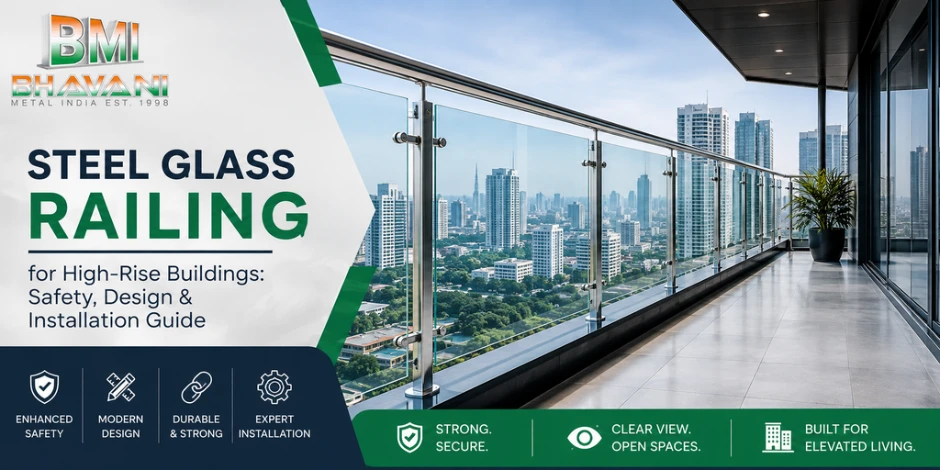
Steel Glass Railing for High-Rise Buildings: Safety, Design & Installation Guide
Balconies, terraces, staircases, and podium edges on a high-rise building carry a safety responsibility that ground-floor railings never face - a failure at the 20th floor is not a minor incident. Steel glass railing systems have become the standard solution because they combine structural steel's load-bearing strength with glass's uninterrupted sightlines.Developers searching for Steel Glass Railing India for a new tower, or a contractor sourcing steel glass railing in Mumbai for a coastal high-rise project, are usually balancing the same three concerns: load rating, glass safety type, and fixing method. This guide covers all three, along with the standards, suppliers, and installation practices that determine whether a railing performs safely for decades.
What Is Steel Glass Railing for High-Rise Buildings?
Steel glass railing for high-rise buildings is a guardrail system combining a structural steel frame, post, or spigot base with toughened or laminated safety glass panels, engineered to resist human impact load, wind load, and dead load at height - used on balconies, terraces, staircases, and podium edges where fall protection and unobstructed views are both required.
Unlike ground-level decorative railing, high-rise steel glass railing must be designed against calculated wind pressures and human impact forces referenced in the National Building Code of India and structural codes like IS 800 and IS 1893. The steel component - whether a full frame, base channel, or individual spigots - carries the structural load, while the glass is chosen for its post-breakage behavior rather than appearance alone.
Definition: What Is a Steel Glass Railing System?
A steel glass railing system is a guardrail assembly where structural steel components (posts, base channels, spigots, or top rails) hold safety glass panels in place, forming a barrier that meets building code requirements for fall protection while maintaining visual openness.
The core components are:
- Base fixing - spigot, channel, or clamp system anchored into the slab, beam, or wall
- Steel structure- posts, handrails, or base channels in mild steel or stainless steel
- Glass panel - toughened (tempered) or laminated safety glass, sometimes both combined
- Handrail - top-mounted steel or stainless-steel rail, required in most residential and commercial codes
- Seals and gaskets - EPDM or silicone gaskets between glass and steel fixing points
- Fasteners - structural-grade bolts and anchors rated for the calculated load
In high-rise applications, each element is specified against a calculated design load - not a generic "standard" railing - because the consequences of under-specification are severe.
Key Features of Steel Glass Railing Systems
The defining features of high-rise steel glass railing are a frameless or semi-frameless glass appearance, structural steel base fixing rated for calculated wind and impact loads, toughened or laminated safety glass, corrosion-resistant stainless steel or powder coated mild steel components, and code-compliant handrail height and glass thickness.
- Frameless or semi-frameless design - glass held by spigots or a slim base channel for unobstructed views
- Structural steel base fixing - spigot, U-channel, or post-and-rail systems engineered for the specific load case
- Corrosion-resistant steel - stainless steel grade 304 or 316 for coastal and high-humidity exposure
- Code-compliant handrail height - typically 900mm–1100mm depending on building type and local code
- Concealed or exposed fixing options - spigot (exposed) vs. channel (concealed base) depending on design intent
- Drainage-friendly base details - preventing water pooling at the glass-to-steel junction
Benefits of Steel Glass Railing in High-Rise Construction
Steel glass railing offers high-rise developers a combination of certified structural safety, unobstructed views, low maintenance, and long service life, making it the preferred guardrail solution for balconies, terraces, staircases, and podium edges on residential and commercial towers across India.
| Benefit | Why It Matters at Height |
|---|---|
| High load-bearing capacity | Steel base resists wind and human impact loads reliably |
| Unobstructed sightlines | Glass panels preserve views that solid parapets block |
| Corrosion resistance (stainless steel) | Withstands coastal humidity and salt exposure |
| Low maintenance | No repainting cycle required with stainless steel or powder coated finish |
| Design flexibility | Frameless, semi-frameless, and framed options for different aesthetics |
| Code compliance | Engineered systems meet NBC and structural safety requirements |
| Long service life | 25+ years with correct glass type and steel grade |
Types of Steel Glass Railing
The main types of steel glass railing used in high-rise buildings are spigot-fixed frameless railing, U-channel base-fixed railing, post-and-handrail railing, and side-mounted fascia railing - each suited to a different balance of structural support, glass thickness, and architectural appearance.
- Spigot-Fixed Frameless Railing - Individual stainless steel spigots clamp the glass base, giving a fully frameless appearance; common on balconies and terraces.
- U-Channel Base-Fixed Railing - Glass sits in a continuous steel channel anchored to the slab edge; offers strong lateral support and a clean base line.
- Post-and-Handrail Railing - Steel posts support a top handrail with glass infill panels between posts; common on staircases and podium edges.
- Side-Mounted (Fascia-Fixed) Railing - Steel brackets fix to the side of the slab rather than the top, preserving usable floor space; used where the slab edge cannot be drilled from above.
- Semi-Frameless Railing - A slim steel top rail combined with a base channel or spigot fixing, balancing structural stiffness with an open appearance.
Applications: Residential vs. Commercial High-Rise Railing
Residential steel glass railing in apartment towers is typically specified for balconies and terraces with a focus on view preservation and aesthetics, while commercial steel glass railing in office towers and mixed-use buildings is specified for staircases, podium decks, and public-facing edges with a stronger emphasis on code compliance and heavy foot-traffic durability.
- Balcony and Terrace Railing - Frameless spigot or channel-fixed systems that preserve views from apartments
- Staircase Railing - Post-and-handrail systems designed for continuous handrail compliance and higher foot traffic
- Podium and Deck Edge Railing - Heavier-duty systems on shared amenity decks, often requiring higher load ratings due to public access
- Commercial Atrium and Mezzanine Railing - Structural glass balustrades in lobbies and office floors, often specified with laminated glass for added safety margin
Technical Specifications to Check Before Specifying
Before specifying steel glass railing for a high-rise project, confirm the design load rating (human impact and wind load per NBC/IS 875), glass type and thickness (toughened vs. laminated), steel grade (mild steel vs. stainless steel 304/316), handrail height per applicable code, and fixing method compatibility with the slab or structure.
| Specification | Typical Range for High-Rise Use |
|---|---|
| Glass thickness | 10mm – 12mm toughened; 10.76mm – 13.52mm laminated (varies by span) |
| Glass type | Toughened (tempered) or laminated safety glass |
| Steel grade | Mild steel (powder coated) or Stainless Steel 304/316 |
| Handrail height | 900mm (residential) to 1100mm+ (commercial/public, per local code) |
| Design load (horizontal) | Per IS 875 Part 3 and project structural engineer calculation |
| Spigot/base spacing | Typically, 1000mm–1200mm centers, engineer-verified per load case |
| Fixing type | Spigot, U-channel, side-mount bracket |
Never accept a "standard" load rating without the actual calculation for your building's height and exposure category. Wind pressure and required human impact resistance both increase with building height and openness of the site, so the same railing detail that works on a 5th-floor balcony may be under-specified on a 25th-floor terrace.
Materials Used in Steel Glass Railing Systems
High-rise steel glass railing uses mild steel (typically powder coated) or stainless steel grade 304/316 for the structural base, toughened or laminated safety glass for the infill panels, EPDM or silicone gaskets at fixing points, and structural-grade stainless steel fasteners rated for the calculated load.
1. Steel Options:
- Mild Steel (Powder Coated) - cost-effective, requires a quality powder coat finish for corrosion resistance
- Stainless Steel 304 - good general corrosion resistance, suitable for most inland applications
- Stainless Steel 316 - higher molybdenum content, recommended for coastal and high-chloride environments like Mumbai
2. Glass Options:
- Toughened Glass - heat-strengthened for impact resistance; breaks into small, less hazardous fragments
- Laminated Glass - interlayer (PVB or SGP) holds glass together after breakage, critical for fall-prevention at height
- Toughened Laminated Glass - combines both properties, often specified for the highest floors or public-access areas
3. Fixing Hardware:Stainless steel spigots, channels, and bolts rated for the structural load case
Manufacturing Process Overview
Steel glass railing components are manufactured through steel cutting and fabrication of posts, channels, or spigots, surface treatment (powder coating or passivation for stainless steel), CNC precision drilling for fixing points, and separate toughening or lamination of glass panels to project dimensions - followed by load testing before site delivery.
- Steel Fabrication - Posts, channels, or spigots are cut, welded, and machined to project specification.
- Surface Treatment - Mild steel is powder coated; stainless steel is passivated or brushed/polished for finish.
- Precision Drilling - Fixing holes are CNC-drilled for accurate on-site alignment.
- Glass Processing - Glass is cut to size, then toughened and/or laminated in a certified glass processing facility.
- Quality Testing - Sample assemblies are load-tested against the specified design pressure.
- Packing & Dispatch - Steel and glass components are packed separately with edge protection for site delivery.
Quality Standards and Industry Certifications
Reputable steel glass railing manufacturers in India align with structural design codes including IS 800 (steel structures), IS 875 Part 3 (wind loads), IS 1893 (seismic considerations), the National Building Code of India for guardrail and handrail safety, and glass-specific standards for toughened and laminated glass performance.
- IS 800 - Code of practice for general construction in steel
- IS 875 (Part 3) - Design loads for buildings, including wind load calculations relevant to railing design
- IS 1893 - Criteria for earthquake-resistant design, relevant to fixing detail in seismic zones
- National Building Code of India (NBC) - Guardrail height, loading, and fall-protection provisions
- ASTM / EN 12600 - International reference standards for glass impact classification, often used alongside Indian codes for glass specification
- ISO 9001 - Quality management certification for the manufacturing facility
A railing system without an engineer-stamped load calculation for the specific building is a liability risk regardless of how it looks - visual similarity to a compliant system does not guarantee equivalent performance.
Comparison: Steel Glass Railing vs. Aluminum Railing vs. Solid Parapet
Steel glass railing offers a stronger load-bearing capacity than aluminum railing systems and preserves views that a solid parapet blocks entirely, making it the preferred choice for high-rise balconies and terraces where both safety compliance and visual openness matter.
| Factor | Steel Glass Railing | Aluminum Railing | Solid Parapet |
|---|---|---|---|
| Load-bearing capacity | High | Moderate | High (but heavy, structural) |
| View preservation | Excellent (frameless glass) | Good (depends on infill) | None |
| Corrosion resistance | High (stainless steel) | High | Depends on material (RCC/masonry) |
| Weight impact on structure | Moderate | Low | High |
| Aesthetic appeal | Premium, modern | Functional | Traditional, heavy |
| Typical lifespan | 25+ years | 20–25 years | 40+ years (with maintenance) |
| Cost | Mid to High | Low to Mid | Low to Mid (construction-dependent) |
Comparison: Toughened vs. Laminated Glass for Railings
Toughened glass resists impact and breaks into small, relatively safe fragments, while laminated glass holds together after breakage due to its interlayer - making laminated or toughened-laminated glass the safer choice for high-rise railings where a fallen glass panel poses a serious risk to people below.
| Factor | Toughened Glass | Laminated Glass |
|---|---|---|
| Impact resistance | High | High |
| Post-breakage behavior | Shatters into small pieces, can fall out | Stays intact due to interlayer |
| Recommended for | Lower floors, contained areas | High-rise, public-facing, above pedestrian areas |
| Cost | Lower | 20–40% higher |
| Best practice | Combine with laminated for critical applications | Preferred alone for tall buildings |
Advantages of Steel Glass Railing
- Strong load-bearing capacity engineered to code
- Preserves unobstructed views compared to solid parapets
- Corrosion-resistant with stainless steel, ideal for coastal cities
- Low lifetime maintenance compared to painted mild steel or timber
- Modern, premium appearance that adds resale value
- Flexible design options: frameless, semi-frameless, framed
Disadvantages of Steel Glass Railing
- Higher upfront cost than basic mild steel pipe railing
- Requires precise structural calculation - not a "one size fits all" product
- Glass replacement after damage requires specialist handling
- Poor-quality mild steel without adequate coating can corrode in coastal climates
- Improper fixing spacing or grade can compromise safety despite looking similar to compliant systems
Buying Guide: How to Choose Steel Glass Railing for a High-Rise Project
To choose the right steel glass railing for a high-rise building, confirm the design load rating against your project's structural engineer specification, select glass type based on floor height and public exposure, choose steel grade based on environmental exposure, and shortlist manufacturers who can provide load calculations and installation supervision.
Decision Tree
1. What is the application?
- Balcony/terrace (private access) → Spigot-fixed frameless railing with toughened glass may suffice
- Staircase/public corridor → Post-and-handrail railing with laminated glass recommended
- Podium/public deck → Higher load-rated system with toughened-laminated glass required
2. What is the environmental exposure?
- Coastal/high humidity (e.g., Mumbai) → Stainless steel 316 recommended
- Inland, moderate exposure → Stainless steel 304 or well-coated mild steel acceptable
3. What is the floor height/public exposure?
- Below 10th floor, private access → Standard toughened glass generally acceptable
- Above 10th floor or public access below → Laminated or toughened-laminated glass strongly recommended
Buyer Checklist
- Design load rating confirmed against structural engineer's calculation
- Glass type selected based on floor height and public exposure below
- Steel grade matched to environmental exposure (304 vs. 316 vs. coated mild steel)
- Handrail height confirmed against applicable local code
- Fixing method (spigot/channel/side-mount) confirmed compatible with slab detail
- Load test reports or engineer certification available from manufacturer
- Installation team experienced with high-rise access and safety protocols
- Warranty terms on steel finish and glass covered in writing
- After-sales glass replacement service confirmed
Installation Guide for High-Rise Steel Glass Railing
Installing steel glass railing in high-rise buildings requires accurate slab-edge measurement, structural anchoring using fasteners rated for the calculated load, precise glass placement with setting blocks and gaskets, and a final load and alignment check - carried out by trained crews using certified fall-protection equipment at height.
- Site Survey & Layout Marking - Confirm slab edge condition and mark spigot/channel positions per shop drawing.
- Anchoring - Fix base spigots, channels, or brackets using anchors rated for the calculated wind and impact load.
- Glass Setting - Position glass panels with setting blocks to maintain correct gap and bite depth.
- Gasket & Seal Installation - Fit EPDM or silicone gaskets at all glass-to-steel contact points.
- Handrail Fixing - Install top handrail (where specified) and verify height compliance.
- Load & Alignment Check - Verify plumb, level, and secure fixing before removing temporary bracing.
- Final Inspection - Confirm glass edge protection, handrail continuity, and overall system rigidity.
On high-rise sites, never install glass panels before the steel base fixing has been independently verified against the shop drawing and load calculation - sequencing errors at height are far costlier to correct than at ground level.
Maintenance Guide: Keeping Steel Glass Railing Performing at Height
- Monthly: Clean glass panels to maintain visibility and remove surface residue
- Every 6 months: Inspect spigot/channel bolts for looseness, retighten to specified torque if needed
- Annually: Inspect gaskets and seals for cracking or degradation; check stainless steel for early corrosion or staining
- Every 2–3 years: Inspect powder coated mild steel finish for chips; touch up or recoat as needed
- As needed: Replace any cracked or damaged glass panel immediately - never leave a compromised panel in place at height
Common Problems and Troubleshooting
The most common problems with high-rise steel glass railing are loose base fixings from vibration or thermal movement, water staining or corrosion at the steel-to-glass junction, cracked glass from impact, and handrail misalignment over time - most are addressed through re-torquing, gasket replacement, or targeted panel replacement rather than full system replacement.
| Problem | Likely Cause | Fix |
|---|---|---|
| Loose spigot or base fixing | Vibration, thermal cycling, under-torqued bolts | Re-torque to specification; inspect anchor condition |
| Water staining/corrosion at base | Poor drainage detail, wrong steel grade for exposure | Improve drainage; consider upgrading to 316 stainless steel |
| Cracked glass panel | Impact damage or point-load stress | Replace panel immediately with certified matching specification |
| Handrail misalignment | Structural settling or fixing wear | Adjust brackets, re-verify level and plumb |
| Gasket degradation/whistling | UV/weather exposure over time | Replace EPDM/silicone gasket |
| Rust streaks on mild steel | Powder coat chip or scratch exposing bare metal | Touch up coating promptly to prevent spread |
Pricing Factors for Steel Glass Railing
The price of steel glass railing depends on steel grade (mild steel vs. stainless steel 304/316), glass type and thickness (toughened vs. laminated), fixing method (spigot vs. channel vs. side-mount), design load requirements, finish quality, and project scale - high-rise projects typically cost more per running meter than low-rise due to higher load ratings and testing requirements.
- Steel grade - Stainless steel 316 costs more than 304, which costs more than powder coated mild steel
- Glass type - Laminated and toughened-laminated glass cost more than toughened glass alone
- Fixing method - Spigot fixing (frameless) is often more labor-intensive to install than channel-based systems
- Design load - Higher wind zones or public-access areas requiring heavier steel sections increase cost
- Finish - Polished or brushed stainless steel typically costs more than standard mill finish
- Order volume - Bulk orders across an entire tower typically secure better per-meter pricing than small custom runs
Supplier Selection Guide: Choosing a Steel Glass Railing Manufacturer
When selecting a steel glass railing manufacturer in India, evaluate their in-house fabrication capability, ability to provide engineer-certified load calculations, project references on comparable high-rise buildings, glass sourcing quality, and warranty terms - not price alone, since an under-specified railing is a life-safety risk rather than a cosmetic shortfall.
Supplier Evaluation Checklist
- Manufacturing facility with ISO 9001 or equivalent quality certification
- Ability to provide structural engineer-certified load calculations per project
- Reference projects on buildings of similar height and public exposure
- Sourcing transparency for toughened/laminated glass (certified glass processor)
- Clear warranty terms on steel finish, glass, and fixing hardware
- Local presence or service network for glass replacement and after-sales support
- Transparent lead times and fabrication capacity for bulk orders
- Willingness to provide a mock-up panel before full order confirmation
Myths vs. Facts
- Myth:"Any stainless-steel railing is corrosion-proof."
- Fact:Stainless steel grade matters - 304 can still develop surface corrosion in high-chloride coastal air, while 316 is specifically formulated for that environment.
- Myth: "Toughened glass alone is always safe enough for high-rise railings."
- Fact: Toughened glass resists impact well but can still fall out in fragments after breakage; laminated glass is the safer choice above pedestrian areas or on higher floors.
Industry Trends and Future Outlook
The steel glass railing industry in India is trending toward stainless steel 316 adoption in coastal markets, wider use of toughened-laminated glass as a default rather than an upgrade, slimmer spigot and channel profiles for a more frameless aesthetic, and greater emphasis on engineer-certified documentation as RERA and structural audit scrutiny increases.
- Toughened laminated glass is becoming the de facto standard for high-rise and public-access applications, not just an optional upgrade
- Stainless steel 316 adoption is rising in coastal metro markets as developers factor in long-term corrosion cost
- Slimmer fixing hardware is being engineered to maximize the frameless appearance architects request
- Digital documentation load calculations, test certificates, and installation records are increasingly requested during structural audits and RERA compliance checks
- Retrofit demand is growing as older buildings upgrade from solid parapets or basic mild steel railing to certified steel glass systems
Case Studies: Illustrative High-Rise Applications
- Coastal Residential Tower, Western India: A 28-storey residential tower facing direct sea exposure specified stainless steel 316 spigot-fixed railing with toughened-laminated glass on all balconies, prioritizing long-term corrosion resistance over the lower upfront cost of 304-grade steel - a decision justified by avoiding early refurbishment in a high-chloride environment.
- Commercial Office Tower, Metro City: A commercial tower's staircase and podium deck specified post-and-handrail steel glass railing with laminated glass throughout public-access areas, while private terraces on upper floors used a lighter spigot-fixed system with toughened glass - showing how specification can vary by public exposure even within one building.
- High-Rise Renovation Project: An older residential tower replaced its original solid RCC parapet with steel glass railing during a façade renovation, requiring a full structural load assessment of the existing slab edge before fixing - illustrating why retrofit projects need additional engineering verification beyond new-build specification.
Frequently Asked Questions
1. What is steel glass railing?
Steel glass railing is a guardrail system where structural steel components - posts, spigots, or channels - hold safety glass panels in place, providing fall protection while maintaining an open, unobstructed view.
2. Is steel glass railing suitable for high-rise buildings?
Yes. When engineered with the correct steel grade, glass type, and load rating for the building's height and exposure, steel glass railing is one of the most widely used guardrail solutions for high-rise balconies, terraces, and staircases in India.
3. What is the difference between Steel Glass Railing India and imported systems?
Steel glass railing manufactured in India is typically designed against Indian structural codes (IS 800, IS 875) and local wind and seismic data, while imported systems may follow European or American codes that require validation against Indian building requirements before use.
4. Why is steel glass railing popular in Mumbai specifically?
Mumbai's coastal exposure and high humidity make steel grade selection critical, and steel glass railing with stainless steel 316 and laminated glass performs reliably against salt-air corrosion and monsoon conditions while preserving skyline views from high-rise balconies.
5. What is the difference between toughened and laminated glass in railings?
Toughened glass is heat-strengthened for impact resistance but can fragment and fall out after breakage, while laminated glass has an interlayer that holds the glass together even after it cracks, making it safer for high-rise and public-access applications.
6. What steel grade is best for steel glass railing?
Stainless steel 316 is recommended for coastal and high-humidity environments due to superior corrosion resistance, while stainless steel 304 or well-coated mild steel can be suitable for inland, lower-exposure applications.
7. How much load can steel glass railing withstand?
Load capacity depends on the specific fixing method, steel section, and glass thickness; a structural engineer calculates the required design load based on IS 875 wind data and the building's height and use, and the manufacturer must certify the system to that rating.
8. What is the lifespan of steel glass railing?
With correct steel grade selection, glass specification, and maintenance, steel glass railing typically lasts 25 years or more, with stainless steel systems often outlasting powder coated mild steel in coastal environments.
9. Is steel glass railing safe for balconies on very high floors?
Yes, provided the system is engineered and certified for the specific floor height and wind exposure, with laminated or toughened-laminated glass recommended above the point where a falling fragment would pose serious risk to people below.
10. What is the difference between spigot-fixed and channel-fixed railing?
Spigot-fixed railing uses individual steel clamps at the glass base for a fully frameless look, while channel-fixed railing sets the glass into a continuous steel channel, offering strong lateral support with a slightly different base appearance.
11. How do I choose a steel glass railing manufacturer in India?
Evaluate their fabrication certification, ability to provide engineer-certified load calculations, project references on comparable buildings, glass sourcing quality, and warranty and after-sales support terms.
12. What is the cost difference between steel glass railing and aluminum railing?
Steel glass railing is generally priced higher than aluminum railing due to steel's greater load-bearing capacity and the cost of safety glass, but it offers stronger structural performance for high-rise and public-access applications.
13. Can steel glass railing be customized?
Yes, steel glass railing can be customized in steel grade, fixing method, glass type and thickness, and finish (powder coated, brushed, or polished) to match project specifications and architectural intent.
14. What glass thickness is required for high-rise railings?
Glass thickness typically ranges from 10mm to 12mm for toughened glass and slightly more for laminated configurations, but the exact thickness depends on panel size, span between fixings, and the calculated design load.
15. How often should steel glass railing be maintained?
Glass should be cleaned monthly, base fixings inspected for looseness every six months, and gaskets and steel surfaces checked annually for wear or early corrosion.
16. What causes corrosion in steel glass railing?
Corrosion is most often caused by using an inadequate steel grade for the environment (e.g., 304 instead of 316 in coastal air), poor drainage detailing at the base fixing, or damage to the powder coat finish exposing bare mild steel.
17. Is steel glass railing earthquake-resistant?
Steel glass railing itself is not typically load-bearing for the structure, but its fixing detail should account for seismic movement per IS 1893 where applicable, particularly in higher seismic zones.
18. What is the difference between commercial and residential steel glass railing?
Commercial steel glass railing is typically specified for staircases, podiums, and public-access areas with laminated glass and higher load ratings, while residential steel glass railing on private balconies can often use standard toughened glass with lighter fixing systems.
19. Does steel glass railing require a structural engineer's approval?
For high-rise applications, yes - the design load, fixing spacing, and glass specification should be certified by a structural engineer against the project's wind and seismic data, not selected from a generic catalog rating.
20. What is the typical warranty on steel glass railing?
Warranties vary by manufacturer but commonly range from 5 to 10 years on steel structure and finish, with glass typically covered separately against manufacturing defects rather than impact damage.
21. Can existing high-rise buildings retrofit steel glass railing?
Yes, retrofitting is common during façade renovation, but it requires a structural assessment of the existing slab edge or wall condition to confirm it can support the new railing's calculated load.
22. How is steel glass railing different from a solid parapet?
A solid parapet is a continuous masonry or RCC barrier that fully blocks views, while steel glass railing provides equivalent fall protection with a transparent glass infill, preserving sightlines from balconies and terraces.
23. What certifications should a steel glass railing supplier have?
Look for ISO 9001 manufacturing certification, structural design compliance with IS 800/IS 875, and certified glass processing for toughened and laminated glass panels.
24. Is it better to buy directly from a manufacturer or through a dealer?
Buying directly from a steel glass railing manufacturer in India often provides better technical support and load documentation for large projects, while dealers or suppliers may be more convenient for smaller, faster-turnaround jobs.
25. What is the difference between mild steel and stainless-steel railing?
Mild steel railing is generally lower cost but requires a quality powder coat finish to resist corrosion, while stainless steel offers inherent corrosion resistance and a premium finish, making it preferable for high-rise and coastal applications.
Specifying steel glass railing for a high-rise building is fundamentally a safety decision dressed as a design choice. The right system depends on floor height, public exposure below, environmental conditions, and a manufacturer's ability to back their railing with an actual engineer-certified load calculation rather than a generic catalog claim. Whether the project is a coastal residential tower sourcing steel glass railing in Mumbai or a commercial development specifying Steel Glass Railing India at scale, the fundamentals stay the same: verify the load calculation, verify the glass type, and verify the steel grade before the order is placed.